Great summary
@rayzazoo. I really CAN feel the independent shock control just driving down the street. That is one of its big differences that I have enjoyed.
The one item that looks interesting is the comfort numbers, and the most easy to change. Less is softer as the default or at no input from driver. Sport rides more soft than street! I am going to drive it a bit today and see if I can feel the ride difference btw Street and Sport. I’ll start there.
Let’s hear more about the acceleration deal. Ray says
1500ms, I may just change it and see if I can perceive something there too.

It can accelerate if I want it to.
I think it'll be dependent on the setup. Once you hit 60mph or the threshold timer, the acceleration table is done.
So let's say est. 0-60mph - threshold timer = time not in accel table
Hellcat 3.7 s - 1.5 s = 2.2
Redeye 3.4 s - 1.5 s = 1.9
SS 3.25 s - 1.5 s = 1.75
Diablosport only spent 1 second in the accel table while DSC had 2 seconds. When Mike from DSC was made aware of the DS controller, the feedback was 1.5 seconds might be the sweet spot, but that was also for a 2015 Hellcat. Once the timer is done, it goes back to the GForce table and %.
Another thing to consider is actual 60ft times. If these are <2 seconds, then it helps explain why DiabloSport elected for only 1 second vs DSC 2 seconds.
I think a more accurate measurement is log personal 0-60 ft times. Then tweak the threshold timer.
Next, tweak the acceleration table % on the desired amount of front and rear.
Interestingly, the 2018 Demon launch suspension strategy: "Bilstein adaptive dampers are set to firm up compression and rebound in the rear while softening front rebound, letting the front end rise freely as weight shifts entirely to the back wheels" Great for a wheelie.
Then the 2023 Demon 170 "raises the nose more slowly, putting more energy into forward acceleration instead of a dramatic wheelie." Slower front rise.
Between these observations and
@catdad settings of 100 (firm) / 10 (soft), it could explain why it's a more planted feeling with little to no wheel spin.
Controlled front extension with maximum rear compliance—reducing wasted pitch and oscillation while maintaining rear-tire loading.
That is much closer to the Demon 170 philosophy than the factory DSC 10/20 soft-front/soft-rear launch map.
@catdad phrase “a ton of pressure on the rear” is describing rear-tire loading, not firm rear damping.
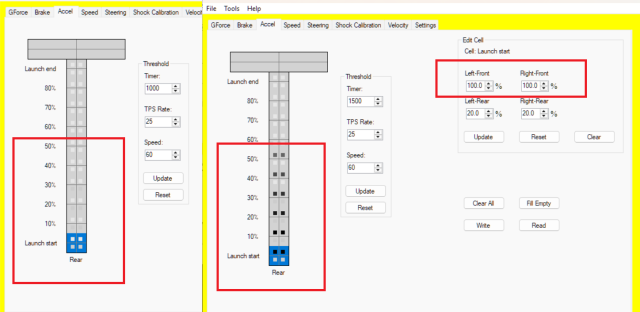
Comparing the G-force table at 0.6 and Launch Start accel table:
OEM launch calibration
Front: 60% → 10%
Rear: 80% → 20%
Both ends become dramatically softer. The front can extend easily, and the rear can compress easily. This encourages weight-transfer motion, but it can also create more pitch, oscillation, or wheel hop.
User calibration
Front: 60% → 100%
Rear: 80% → 10%
This is a radically different strategy:
Front becomes much more controlled.
Rear becomes almost completely released.
It is best described as:
Firm front, very soft rear.
The acceleration itself still transfers load rearward. The stiff front controls how quickly the nose moves, while the soft rear lets the suspension absorb the torque application and load the rear tires.
For the 100/10, it could be more effective on an unprepared surface or street-oriented tire when the problem is immediate wheelspin.
The DSC 10/20 setting may work better when the surface is prepared and the tires can tolerate a more aggressive weight-transfer event.

 2
2
 1
1
 1
1